





 Share
Share






Musk ran the poll himself. Over 1.5 million people voted. Then he posted a single word in reply to the results: “Sigh.” Marketers should pay attention.
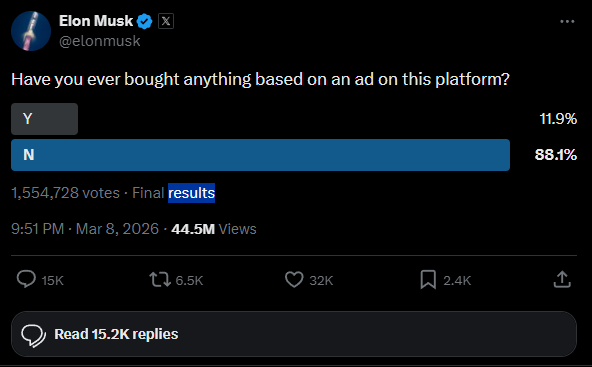
There are studies. There are agency reports. There are whitepapers full of brand safety metrics and engagement benchmarks that marketing teams commission and then quietly file away. But nothing cuts through the noise quite like the owner of a platform asking his own users if his platform’s ads work, getting a catastrophic answer, and responding with a sad face emoji.
That is what happened earlier this month. Elon Musk posted a poll to X: “Have you ever bought anything because of an ad on this platform?” Over 1.55 million users voted. The poll hit 43 million views. And the result was not close.
88%
of 1.55 million X users said they have never bought anything because of an ad on the platform.
Musk’s response: “Sigh.”
Twelve percent said yes. Eighty-eight percent said no. Musk replied to his own poll with one word and a crying emoji. For a platform that still depends on advertising as its primary revenue source, those are numbers that should be on the wall of every media planning meeting in the industry.
This didn’t come out of nowhere
The poll result is surprising only if you haven’t been paying attention. The data on X’s advertising effectiveness has been pointing in this direction for years. U.S. ad spending on X by major agencies dropped 54% in the year following Musk’s acquisition of the platform. Disney, IBM, Warner Bros. Discovery, Sony, Comcast, and NBCUniversal all pulled their spending. Musk’s response to the advertiser exodus was to tell them, on stage at the New York Times DealBook Summit, to “go f*** yourself.” He later sued some of them.
The brands that stayed, or eventually returned, did so cautiously. And the poll result explains why caution was warranted. It isn’t just that users ignore ads on X. It’s that the platform’s entire architecture works against commercial intent.
54%drop in U.S. ad spend by major agencies after Musk’s takeover
43Mviews on Musk’s own poll about ad effectiveness
12%of users who said they’ve ever bought from an X ad
The algorithm is the problem
X’s recommendation engine, now fully powered by Grok, is optimized for one thing: keeping users engaged. And the content that keeps users most engaged, according to both the open-sourced algorithm code and multiple peer-reviewed studies, is content that generates anger. Emotionally charged, partisan, outrage-driven posts consistently outperform everything else on the platform.
Here is the problem for marketers: rage is not a purchasing state. When someone is furious about a political post, their amygdala is running the show. They are not in a frame of mind to evaluate a product, consider a value proposition, or make a considered purchase decision. They are in fight mode. Your ad, no matter how well-targeted or beautifully produced, is landing in the middle of a neurological stress response.
What the research says
A pre-registered algorithmic audit found that Twitter’s engagement-based ranking algorithm specifically amplifies emotionally charged, out-group hostile content. Separate research confirms anger spreads faster on social media than any other emotion and generates more raw engagement. The platform has optimized so hard for that one signal that it has built an audience in a near-permanent state of agitation. That audience is not browsing. It is not shopping. It is scrolling and reacting.
The mindset problem no targeting can fix
Marketers have spent years trying to solve X’s ad performance problem with better targeting. Tighter audience segments. Smarter creative. AI-matched placements. Musk himself promised in 2025 that Grok-powered ad matching would finally connect users with products they actually want, turning ads into content. “An ad that meets a user’s needs, if it’s a product or service that they want, especially when they want it, that is actually content,” he said.
The poll result from two weeks later suggests that Grok has not solved it. And it probably cannot, because the problem is not targeting. The problem is context. You cannot put a user in a buying mindset through better creative if the platform has spent the last 45 minutes making them furious about something they read three tabs ago. The emotional residue of an outrage loop does not clear between the rage reply and your ad.
You cannot put a user in a buying mindset through better creative if the platform has spent the last 45 minutes making them furious.
What this means for your media plan
None of this means X is useless for marketing. It means you need to be honest about what it is and is not good for. X is a PR and reputation platform. It is where news breaks, where journalists watch, where cultural moments happen in real time. If your goal is brand visibility, thought leadership, or being part of a conversation that matters in your industry, X can deliver that. Some brands use it well for exactly those purposes.
What it is not, based on the owner’s own poll and years of advertiser data, is a platform where users are primed to buy. If your campaign objective is direct response, conversion, or revenue, the 88% number is telling you something your agency’s pitch deck probably isn’t.
The most honest thing a media planner can do right now is look at their X allocation and ask: am I here because the data supports it, or because X still feels like it should work? Those are different questions. Musk’s poll is a useful nudge toward answering the right one.
Sources: Elon Musk poll on X (March 2026), reported by Benzinga; U.S. ad spend data via Guideline/WSJ (2023); DealBook Summit remarks by Elon Musk (2023); Grok algorithm announcement by xAI (2025); peer-reviewed algorithmic audit, Brady et al., ResearchGate.
Next Post









What do you think?
It is nice to know your opinion. Leave a comment.